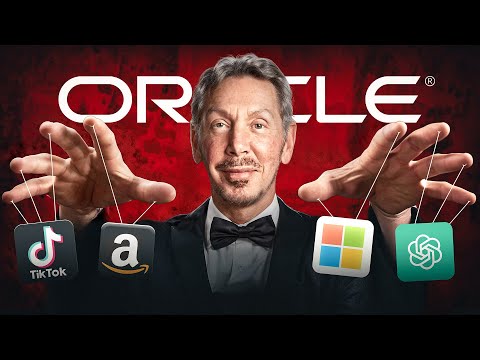
Why Oracle Is The Next Big AI Stock
Duration
12:50
Captions
1
Language
EN
Published
Aug 27, 2025
Description
Join my discord to get my free Trump Tracker: https://discord.gg/GEdg7fpChd Disclaimer: I am not a financial advisor. All content provided on this channel is for entertainment purposes only. Investing involves risk and you must do your own research. AI is creating some of the biggest financial opportunities in history—but picking the right stocks is harder than ever. In this video, I break down why Oracle, once dismissed as a sleepy software dinosaur, is suddenly one of the most explosive AI plays hiding in plain sight. From its roots building CIA databases to its “Generation 2 Cloud” built for AI workloads, Oracle has positioned itself to power the next wave of artificial intelligence. I’ll unpack its history, technology, partnerships, and financials—so you can decide if Oracle deserves a place in your portfolio. 0:00 Intro 0:30: Origins 02:29 Oracle’s Cloud 05:52 The Data Moat 08:03 Financials 10:26 Next 3x AI Stock? #stocks #investing #finance
Captions (1)
AI is changing everything, but it's hard
to find the stocks that will actually
deliver you multiund% returns because of
it. The scariest part of picking AI
stocks right now is that if you make a
mistake, it could cost you the largest
financial returns in the history of
investing. Before I dug into the
research on Oracle, I thought this was
just a sleepy software giant run by a
founder who'd forgotten how to innovate.
But in this video, I'm going to tell you
why Oracle is the most explosive AI
stock hiding in plain sight.
If you want to research an investment
today, it's equally as important to go
back in time and figure out how that
company started because Oracle's roots
say as much about its current AI
strategy as its recent earnings. Back in
1977, Larry Ellison started the company
by building a database for the CIA.
Unlike its tech giant peers, Oracle was
never chasing flashy consumer trends.
From the beginning, it's always been
oriented around solving those
missionritical operations behind the
scenes. This focus helped Oracle become
the world's largest database management
company by 1987. But it wasn't just
Oracle's own products that made it into
the $700 billion giant it is today.
Larry Ellison's aggressive acquisition
strategy executed alongside current CEO
Software Cats was equally important.
Peopleoft for 10 billion, Sevil Systems
for 5 billion, BEA systems for 8.5, and
then Sun Micros Systemystems for $7
billion. Each of these acquisitions
wasn't random expansion. It was
calculated empire building. For Oracle,
this quest was about constructing what
they called a complete technology stack.
Database at the core and then all the
software needed to make use of it.
Oracle's empire today consists of
several critical software applications
the biggest companies depend on from ERP
to CRM. By the early 2010s, this
collection of juggernaut products made
Oracle the backbone of enterprise
computing. Banks processed transactions
on Oracle databases. Governments managed
citizen data through Oracle
applications. Fortune 500 companies,
they ran their entire operations on its
integrated stack. But then something
happened. The market stopped caring.
Between 2010 and 2016, Oracle stock was
basically flat. The cloud looked like it
was the future of enterprise technology.
While Amazon's AWS was growing triple
digits and Microsoft scaled up Azure,
Oracle looked like a relic of Silicon
Valley's past. And Ellison's public
comments didn't help at all. He called
cloud computing complete gibberish and
compared it to a fashion fad that would
go out of style.
>> I mean, the guy say, "Oh, it's in the
cloud." Well, what is that? I mean, it's
this nonsense.
>> The tech press had a field day with it.
Was Oracle the Kodak of enterprise
software? The critics couldn't have been
more wrong.
Ellison's skepticism wasn't about cloud
computing itself. Instead, it was about
how his competitors were implementing
it. And that grudge made Oracle better
positioned for the AI boom than Amazon
or Microsoft. Under the decisive
direction of Saffricats in 2016, Oracle
officially launched what they called
generation 2 cloud infrastructure. While
AWS and Azure were building virtualized
multi-tenant platforms optimized for web
applications, Oracle was engineering
something fundamentally different. Their
bet, the future of cloud wouldn't be
about hosting websites. It would be
about running the most demanding
computational workloads on Earth. Now,
here's the technical difference that
matters. Traditional clouds use
virtualization software that lets
multiple customers share the same
physical server. It's efficient for
general workloads, but it creates
performance overhead and
unpredictability. Oracle went bare metal
instead. direct hardware access with no
virtualization layer eating up
performance. But the real breakthrough
was their networking architecture.
Oracle implemented RDMA over converged
Ethernet, a technology that allows
servers to exchange data directly
between memory without involving
processors. This reduces latency to
microsconds and frees up CPU resources
for actual computation. Most
importantly, Oracle built a non-overs
subscribed network. While competitors
share bandwidth between customers,
Oracle guarantees full network capacity
to each workload. When you need to
connect thousands of processors working
on the same problem, that guaranteed
bandwidth becomes critical. Now, when
Oracle made these decisions, it looked
like overengineering for a niche market.
But then, like I say in literally every
video, Chat GBT launched in 2022.
Suddenly, every company needed large
language models. You know the story. And
training those LLMs requires something
cloud providers had never dealt with
before. Thousands of GPUs working in
perfect sync for weeks at a time.
Oracle's overengineered infrastructure
suddenly became the only architecture
that could handle these workloads
efficiently. While competitors scrambled
to retrofit their platforms for AI
training, Oracle's Gen 2 cloud was
already purpose-built for this exact
type of demanding computation. This
groundup design meant they were also
equipped to charge the best prices.
Oracle delivers 57% cheaper compute than
AWS, 75% cheaper than Azure, and 169%
lower total cost than Google Cloud for
AI training. And on a performance level,
Oracle provides four times more cluster
networking bandwidth than AWS and eight
times more than Google Cloud. Now, I
know this sounds like a bunch of
gibberish, but when you're training AI
models, the differences between these
platforms can compound exponentially.
Oracle's partnerships also make its AI
strategy even more formidable. Their
NVIDIA partnerships saw them deploy some
of the latest Blackwell GV200s, and
their OCI console integrates directly
with NVIDIA software. Now, here's
something I found super interesting when
researching Oracle's cloud. Oracle is
actually working with its competitors as
much as it's competing against them.
Microsoft and Amazon both recently
partnered with Oracle to have it install
its Exadata hardware inside their data
centers. This means customers get
Oracle's database performance with low
latency connections to their existing
cloud applications. The takeaway is that
Oracle is winning in the cloud whether
you go with them or somebody else. And
that's not the only thing that makes
Oracle a super high upside bet for any
thematic AI investor. The Trump
administration is gung-ho on AI. And
when Donald Trump says something on
Truth Social, it can move markets. For
example, in April, when he posted about
the 90-day pause on tariffs, Nvidia
stock shot up over 18%. So, in my
Discord, I built a free AI tool that
will notify you every time Trump posts
and also give you an AI market analysis
to let you know if you should make a
move on anything. You can join my server
at the link in the description. Now,
let's get back to the second part of
Oracle's AI master plan.
AI infrastructure has been all the rage
lately. From AMD to Nvidia to
Cororeweave, these companies provide the
raw materials that are powering the AI
revolution we're seeing play out. But
what makes Oracle such a compelling AI
stock is it's not just infrastructure.
It's not just a commodity. This company
is sitting on some of the most valuable
data on planet Earth. Oracle's dusty old
enterprise software has suddenly become
their biggest strategic asset. Banks,
insurance companies, defense
contractors, governments, they all run
on Oracle databases. We're talking
transaction records, customer profiles,
supply chain data, financial models, the
crown jewels that actually drive
business decisions. Once your mission
critical data lives in Oracle,
everything else gets pulled into its
orbit. Applications, analytics,
workflows, they all naturally cluster
around where the data lives because
moving that data, it's risky, expensive,
and often impossible due to compliance
requirements. Now, here's the master
stroke. With Oracle Database 23 AI,
they've introduced native AI vector
search capabilities. Instead of forcing
customers to extract their sensitive
data and move it to some startups vector
database, Oracle brings AI directly to
where that data already lives. And
that's really just the start of what
Oracle is doing with its traditional SAS
business. In Oracle's March earnings
call, Larry Ellison said, quote, "All
our applications are becoming AI agents.
One such example is the integration of
AI agents for Oracle health customers
and electronic health record systems,
automating tasks like recording
prescriptions and doctor's notes." Now,
I know you've heard this before. You
literally can't go anywhere on LinkedIn
without somebody posting about their AI
agent startup. But few will actually be
able to drive results for big companies
cuz Oracle already has those customers
and they're just going to bring the tech
straight to them. Why risk moving your
most valuable data to an unproven vendor
when you can get AI capabilities baked
into the database you've trusted for
decades? By staying on Oracle and adding
its AI capabilities, that's the path of
least resistance to using AI to
streamline your business. The biggest
point I want to make here before we dive
into Oracle's financials is that if AI
is going to have the impact that the
world thinks it will, it basically has
to drive value for these more
traditional companies, these massive
government agencies, defense companies,
like they have to implement this tech
and Oracle is really providing them the
easiest way to do it. In many ways, I
would argue that Oracle is the key to
proving the AI future is possible.
Oracle's AI narrative is not just a
marketing tagline. It's written all over
the company's earnings and the business
is growing faster than its big tech
peers who get a lot more shine among
investors in the media. For the fourth
quarter of 2024, Oracle reported solid
double-digit growth across its more
traditional business lines like cloud
services and cloud applications. But it
was the cloud infrastructure business
that shocked the street. Oracle's AI
focused infrastructure as a service
business grew by a whopping 52%
year-over-year to $3 billion. To truly
grasp this, we've got to put this growth
rate in perspective. Microsoft Azure's
latest quarter 31% growth. Google Cloud
29%. Amazon Web Services 17%. The
software dinosaur of the 2010s is
growing like a startup compared against
the largest tech companies on Earth. But
there was another number in Oracle's
earnings that was super interesting.
Remaining performance obligations hit
138 billion. That's contracted
non-cancellable future revenue, and it's
up 41% year-over-year. And this growth
isn't projected to slow down. Oracle
estimates their total cloud growth rate,
which is applications plus
infrastructure, will increase 24% in
full year 2025 to over 40% in full year
2026. This accounts for a 70% growth
rate of just the infrastructure segment
in full year 2026, and that's up from an
already 52% right now. The company also
said remaining performance obligations
will double in 2026, which will put
contracted revenue at nearly 300
billion. That's approximately 6 times
Oracle's entire 2024 revenue. But to
pull this off, Oracle's got a hell of a
lot of building to do. The company has
quickly become the largest lesser of
data centers in the United States and
it's also making major investments
around the world which will help it
capitalize on the rise of sovereign AI
where countries are increasingly
requiring their data to remain on shore
as they build AI. For example, Oracle
committed 6.5 billion to build data
centers in Malaysia for bike dance which
is already spending 7 billion a year
with Oracle on GPU access. That doesn't
include another 5 billion for the UK and
3 billion for Germany and the
Netherlands. That's why Oracle's capex
will roughly double in fiscal 2025 and
exceed 25 billion in 2026. In fact,
Oracle's capex last year actually
exceeded its cash from operations,
pushing its free cash flow temporarily
into negative territory. Oracle is
sacrificing short-term margins to, in
Ellison's words, build more cloud
infrastructure data centers than all of
our infrastructure competitors combined.
What's more exciting than a legacy
business that's getting back into the
risk to chase an industry that will make
it cutting edge again?
In January 2025, Sam Alman announced
Stargate, a $500 billion initiative to
build the computing infrastructure that
will power the next generation of AI.
When Alman needed a partner capable of
delivering the specialized high
performance infrastructure his moonshot
required, he didn't choose AWS. He
didn't choose Azure nor Google Cloud. He
chose Oracle. Oracle's Abene, Texas
campus is already operational as part of
Stargate with Oracle committing 2
million NVIDIA chips worth $40 billion.
This isn't just a cloud contract. This
is an AI mega deal. In 2028, Oracle is
expected to rake in over 30 billion in
annual revenue from OpenAI alone, which
with just one customer is 6 billion more
than Oracle's entire cloud business
today. But before we start looking too
far ahead, why don't we just look
backwards? Oracle stock price was $80 in
the summer of 2021. Today it's at $230
in the summer of 2025. That's a nearly
3x appreciation in four years on what's
considered a mega cap stock. So I
figured let's just make a few back of
the napkin estimations to see where
Oracle stock price could go over the
next four years. Let's say Oracle's
cloud business continues its breaknecket
growth growing 40% annually while its
non-cloud business grows 10% annually.
With those numbers, Oracle's revenue
would grow from 57 billion to 128
billion by 2029. then I think it's
highly probable that Oracle's price to
sales ratio changes over time because I
think the market still kind of sees it
as a database company and not a cutting
edge AI hyperscaler. Oracle's price to
sales ratio is currently around 10, but
I think it could creep up to around 13
to match Microsoft, for example, which
is considered an AI hyperscaler. This
would value Oracle at around 1.67
trillion in 2029 at around $600 a share.
That represents a near 3x increase over
today's stock price. To wrap up the
story, this analysis of Oracle feels a
lot about the deep dive I did on AMD
recently. AMD CEO, Lisa Sue, has always
emphasized that in technology, it's the
decisions you make today that determine
your fate years down the road. Back in
2016, Oracle never could have predicted
the design choices around its Gen 2
cloud would become perfectly suited to
AI. But now, we're seeing them pay off a
decade later. The same could happen with
Oracle's massive investments in AI
infrastructure. If Larry Ellison was
right when he said AI will fundamentally
change our lives, Oracle will no doubt
catch an unfathomable amount of the
value it creates. Thank you so much for
watching this video. Join my Discord at
the link in the description if you love
hunting for the next big stock. And if
you want to watch more videos like this,
you could check out this one, which I
think will be right up your alley.